Chicago house, from the Warehouse to the world
How DJs and producers in 1980s Chicago turned disco, drum machines and cheap synths into house music, and how the sound crossed the Atlantic to change club culture for good.
After disco
By 1980, disco had faded from the US charts, but it never left the dancefloors of Chicago's underground clubs. The scene was centered on Black and Latino gay clubs, where DJs kept playing long, emotional sets of disco, soul, European electronic music and anything with a groove.
The most important room was the Warehouse, a club that opened in 1977 with Frankie Knuckles as resident DJ. Knuckles had come from New York, where he had played alongside his friend Larry Levan (see garage). In Chicago he re-edited records on reel-to-reel tape, extended breaks and layered drum machine beats under disco tracks. Record shops began labeling the music people heard there as "Warehouse music," and the name was shortened to house.
Drum machines and bedroom producers
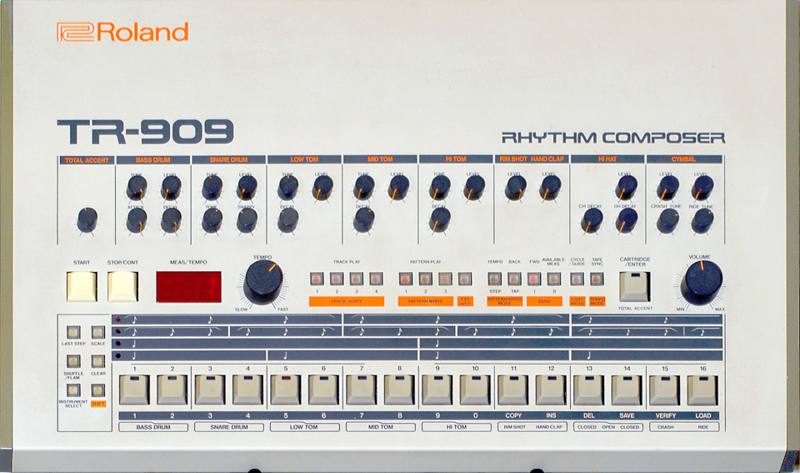
In the early and mid 1980s, affordable gear changed who could make records. Roland's TR-808 and TR-909 drum machines and the TB-303 bass synthesizer were sold cheaply second hand after flopping as products for musicians. Young Chicago producers bought them and made stripped-down tracks for DJs:
- A steady four-to-the-floor kick drum on every beat.
- Open hi-hats on the offbeats.
- Simple, looping basslines and chords.
- Tempos around 118 to 128 BPM.
Jesse Saunders' "On and On" (1984) is often cited as one of the first house records pressed on vinyl. Labels such as Trax Records and DJ International released dozens of tracks by local producers, and classics such as Marshall Jefferson's "Move Your Body" followed.
Radio and the Music Box
Chicago radio helped house spread far beyond the clubs. The Hot Mix 5, a team of DJs on station WBMX, played fast, energetic mixes to a huge audience of teenagers. Meanwhile, at the Music Box, DJ Ron Hardy played a raw, loud and experimental style that pushed producers to make wilder tracks.
Acid house
In 1987 the group Phuture released "Acid Tracks," built on the squelching, resonant sound of a TB-303 with its controls twisted in real time. That sound gave its name to acid house. When it reached the UK, it fueled the "Second Summer of Love" in 1988 and 1989, when acid house parties and raves spread across Britain.
House goes global
| Year | Milestone |
|---|---|
| 1977 | The Warehouse opens with Frankie Knuckles |
| 1984 | Early house records pressed in Chicago |
| 1986 | House tracks begin entering the UK charts |
| 1987 | Steve "Silk" Hurley's "Jack Your Body" reaches number 1 in the UK; "Acid Tracks" released |
| 1988 | Acid house explodes in the UK |
From there, house split into countless styles: deep house, tech house, progressive house, French house and many more. See genres A to Z.
Why it still matters to DJs
House was born from DJ technique. Its long intros and outros, steady kicks and 8-bar phrases were designed to be mixed. If you learn to beatmatch and phrase with house music, you are practicing exactly what the genre was built for. Frankie Knuckles, often called "the Godfather of House," died in 2014, but his records and edits are still played in clubs around the world.
The 808 and 909 sounds are so central to dance music that modern software still copies them, decades after the original machines went out of production.