EQ mixing
How to use the low, mid and high EQ knobs to blend two tracks cleanly, the classic bass swap, and mistakes that make mixes sound muddy.
Why EQ matters
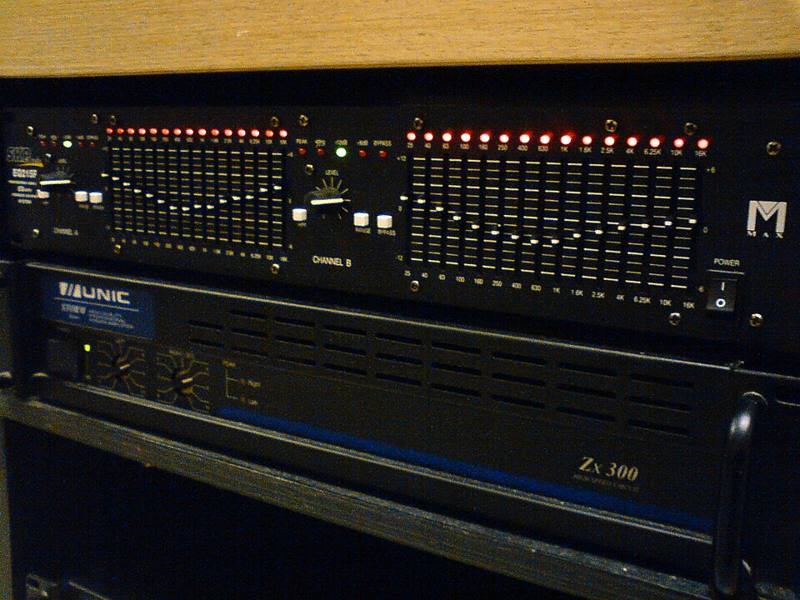
When two full tracks play at once, their frequencies pile up. Two kick drums and two basslines together sound muddy and too loud, and can overload the sound system. EQ (equalization) lets you turn down parts of each track so they fit together, like making space for one person to speak before the next takes over.
The three bands
Most DJ mixers have three EQ knobs per channel. Exact frequencies vary by mixer, but roughly:
| Band | Approx range | What lives there |
|---|---|---|
| Low | Below about 200 Hz | Kick drum body, bassline, sub bass |
| Mid | About 200 Hz to 2 to 5 kHz | Vocals, chords, synths, snares |
| High | Above about 2 to 5 kHz | Hi-hats, cymbals, shakers, air |
On many club mixers, turning a knob fully down removes almost all of that band, called a kill. On others, the cut is softer. Learn how your mixer behaves.
The bass swap
The single most useful EQ technique:
- Beatmatch the incoming track and start it at the beginning of a phrase. See phrasing.
- Before bringing up its fader, turn its low EQ fully down.
- Bring the incoming fader up. Now you hear its hats and mids over the playing track's full sound.
- At the start of a new phrase, swap the lows: turn the old track's low down and the new track's low up at the same moment.
- Over the next phrase or two, gradually lower the old track's mids and highs, then its fader.
Two basslines never play together at full strength, so the mix stays clean and the energy jumps at a phrase boundary, which feels natural.
Other EQ moves
- High swap. Bring in the new track with its highs down, then swap highs later for a subtle blend.
- Mid cut for vocals. If both tracks have vocals, lower the mids of one to avoid two voices fighting.
- Filter sweeps. A filter knob gradually removes lows (high-pass) or highs (low-pass). Sweeping the outgoing track with a high-pass filter is a smooth exit.
- Bass cut on breakdowns. Briefly killing lows on the playing track before a drop makes the drop hit harder.
Common mistakes
| Mistake | Result | Better habit |
|---|---|---|
| Two basslines at full | Muddy, distorted low end | One low at a time |
| Boosting EQs above center | Distortion and harsh sound | Cut instead of boost |
| Using EQ to fix volume | Uneven levels | Match levels with gain first |
| Constant twiddling | Distracting, unstable sound | Make moves on phrase changes |
| Ignoring meters | Clipping and harshness | Watch channel and master meters |
Treat center (12 o'clock) as the starting point. Most of the time, EQ knobs should only go down from there. Boosting the low end on a club system is the fastest way to distortion.
EQ and different genres
- House and techno: Long blends with careful bass swaps.
- Drum and bass: Fast bass swaps on the drop are central to the style. See drum and bass.
- Hip hop and open format: Quicker transitions, often cuts, with EQ used to smooth the edges.
Practice exercise
Pick two tracks with long intros. Mix them ten times using only the bass swap, changing nothing else. Record the practice and listen back on headphones. You will quickly hear the moment when both basslines overlap and learn to avoid it. See recording mixes.