BPM and tempo for DJs
What BPM means, how pitch faders change tempo by percentage, the simple math for matching two tracks, and how halftime and doubletime let you mix across genres.
What BPM means
BPM stands for beats per minute. It measures how fast a piece of music is. A track at 120 BPM has 120 beats every minute, or two beats per second. In most dance music the beat you count is the kick drum.
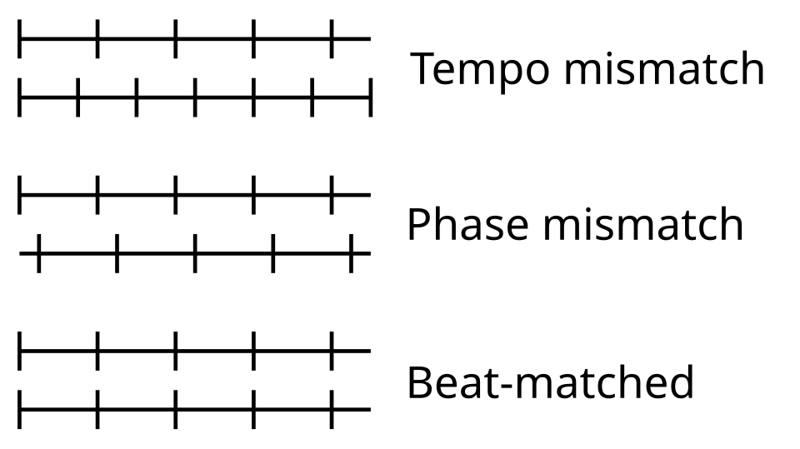
Tempo matters to DJs because two tracks only lock together when they play at the same BPM. That is the whole point of beatmatching.
The pitch fader is a percentage
On turntables, CDJs and controllers, the pitch or tempo fader changes speed by a percentage, not by a fixed number of BPM. Common ranges are plus or minus 8%, 16%, or wider.
The new BPM is:
new BPM = original BPM x (1 + percentage / 100)
Examples:
| Original BPM | Pitch change | New BPM |
|---|---|---|
| 120 | +2% | 122.4 |
| 124 | +3.2% | about 128 |
| 128 | -6% | about 120.3 |
| 174 | -2% | about 170.5 |
To find the percentage you need:
percentage = (target BPM / original BPM - 1) x 100
So to bring a 124 BPM track up to 128: (128 / 124 - 1) x 100 = about 3.2%.
Because it is a percentage, a 1% move changes a 170 BPM track much more than a 90 BPM track: about 1.7 BPM versus 0.9 BPM.
Pitch range settings
| Range | Precision | Use |
|---|---|---|
| Plus or minus 8% | Fine control | Most mixing |
| Plus or minus 16% | Coarser | Larger tempo changes |
| Wide (50% or more) | Very coarse | Effects and special transitions |
A smaller range gives finer control over the same physical fader length, which makes beatmatching by ear easier.
Halftime and doubletime
Music often feels related at double or half the tempo. A hip-hop track at 85 BPM has the same pulse spacing as a drum and bass track at 170, counted every other beat. This lets you:
- Mix hip-hop into drum and bass (85 to 170).
- Mix dubstep at 140 with trap that feels like 70.
- Use halftime breakdowns to shift energy.
Analysis software sometimes detects the halftime or doubletime number by mistake, so trust your ears. See the BPM chart.
How long things take
At a given BPM, you can work out how long a bar or phrase lasts:
- One beat lasts 60 / BPM seconds.
- One bar of 4 beats lasts 240 / BPM seconds.
- At 128 BPM, one bar lasts about 1.9 seconds, and 32 bars last exactly 60 seconds.
This helps you plan when to start a mix. See beats, bars and phrases.
Sync and tempo
Most digital DJ gear has a sync button that matches tempos automatically. It is a useful tool, but it relies on accurate beat grids. Learning tempo by ear means you can fix drift, play records without grids and stay calm when something goes wrong.
Tempo and energy
Faster is not always more energetic. A 122 BPM track with driving percussion can feel bigger than a sparse 130 BPM one. Use tempo as one tool among many when building a set.
Practice guessing BPM by tapping along before you look at the screen. Within a few weeks most DJs can guess within 2 or 3 BPM.